
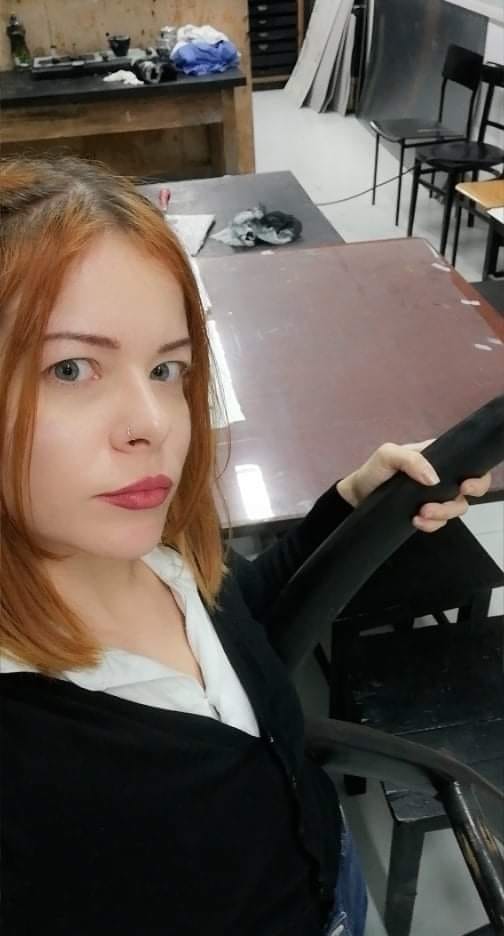
Born 1992 in Čakovec, Croatia. Graphic artist.
During the pandemic year, I create more than before.
Ena Bajuk
The enclosed space during the lockdown provided me with a familiar and safe shelter, but gradually the white walls of the apartment evoked artistic reflection.
Is that white surface a kind of white canvas, a framed paper format I’m just looking at? My lashes tangle and unravel with each blink like thick lines that I will soon compare to brown-green spots in a dissolved canopy through the reflections of the sun.
Then the forms as light notes in my mind, now to the memory and the idea for a new artistic composition. If thoughts sounded, they would cacophonically and asemically represent a pattern articulated only to some extent, open to a known or unknown association yet to be formed. Intense walking in the woods and hiking confirmed to me that nature is a lasting inspiration, in itself a complete pictorial, sound and tactile experience.
It is important to refine the senses, experience every shape, noise and sound, the breeze brushed with buds and nettles, read blisters and skin rashes like Braille, contrasting mud and irritated skin as completed existential images.
And the “pandemic escape”, although completely contrary to the previously described, is a return to the seductive virtuality of a binary and seemingly more ordered world in which pseudo-information reigns.
However, in the absence of my own workspace due to moving to a larger apartment that I am slowly likening to myself, I spontaneously collage my drawings and subsequently digitally process them, thus experimenting with traditional and modern techniques. My own works are a kind of pictorial diary, an abstract record of incidental experiences processed by inner polyphony – all that we take for ourselves and leave behind.
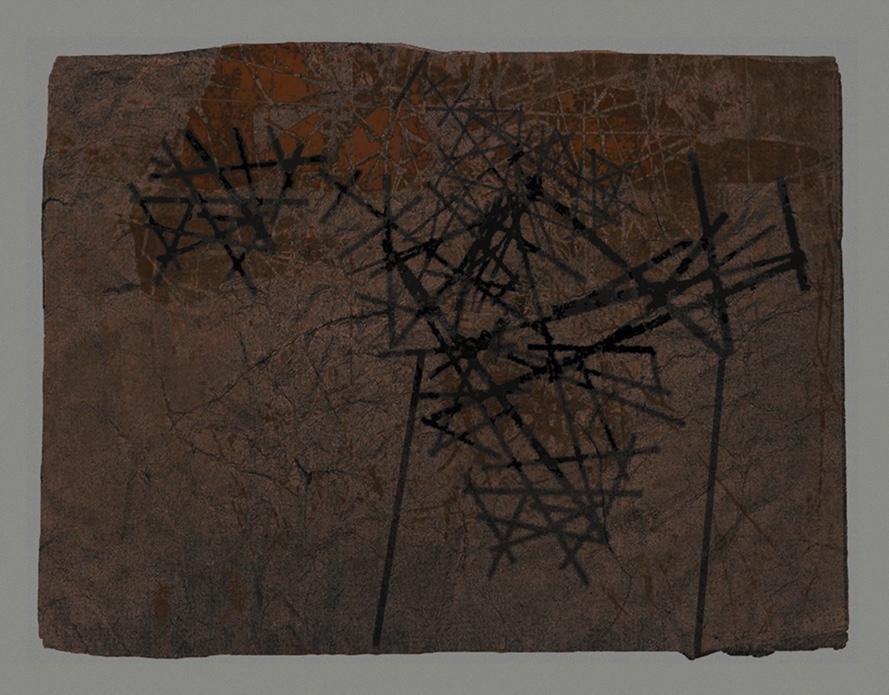
People have been aware of the nature around them since prehistoric times, they worshiped and imitated it. Thus, the rhythms of nature are indisputably woven into tribal and other traditional dances, presented in the distinctive motifs of a local community. These are most often geometric, phytomorphic and animal figures. The ornament “is not an empty play, but a testimony of the spiritual life, it is closely connected with the opinion and feeling of the people who perform it” (H. Stolpe, H. Schurtz, W. Worringer). Repetition as rhythm, rhythm as sound, sound as artistic expression.
#365daysafter art project